Under-eye bags don’t care how much you sleep. That’s the thing nobody tells you until you’ve already tried every eye cream on the shelf and still look exhausted at 8am on a Tuesday. For a lot of people in their 40s, the puffiness and hollowing isn’t a hydration problem or a sleep problem. It’s structural. And structural problems don’t respond to topical anything.
This 40-year-old Richmond patient knew that. She came in with persistent under-eye puffiness, some hollowing along the orbital rim, and skin that looked dull and uneven no matter what she did. She wasn’t chasing a dramatic change. She just wanted to look like herself again, the version that didn’t make people ask if she was tired.
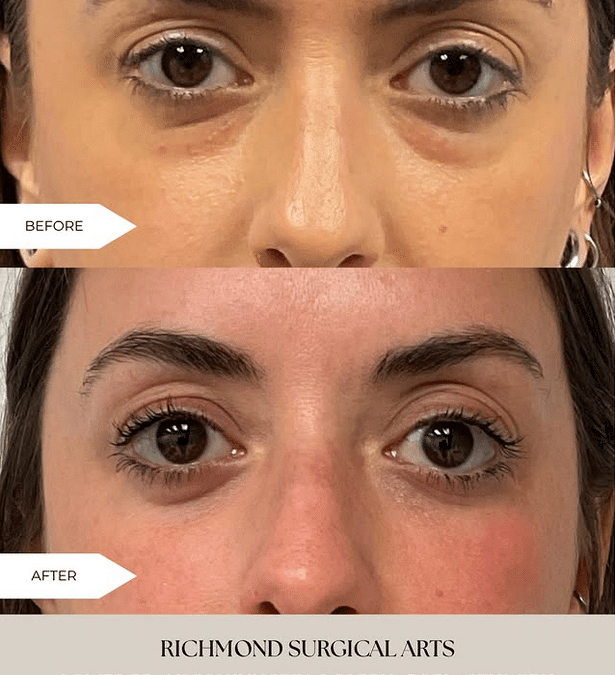
Dr. Gregory T. Lynam planned a combination approach: a lower transconjunctival blepharoplasty, fractionated fat transfer to the orbital rim, and a chemical peel. The photos at three months post-op show what that plan actually produced. The bags are gone. The hollowing is gone. The skin tone is more even. And she still looks like herself.
Here’s a breakdown of what each part of that plan involved and why it was the right fit for this patient.
What Was Actually Going On Under Her Eyes
Under-eye bags and tear trough hollowing tend to show up at the same time, which can seem confusing. The bag is caused by fat pushing forward through a weakened lower eyelid septum. The hollow, or tear trough, is a groove that forms right below it as the face loses volume over time.
Together they create that perpetually tired look. The shadow from the hollow makes the puffiness above it look worse. Skincare doesn’t fix either of those things because the problem is structural, not on the surface. Fillers can sometimes soften the hollow, but they don’t address the fat pushing forward. Surgery is one of the few options that can correct both.
The Transconjunctival Approach: Why No Scar
With a traditional lower blepharoplasty, the surgeon makes an incision just below the lash line on the outside of the eyelid. It’s an effective technique, but it does leave a scar and involves more disruption to the surrounding tissue.
The transconjunctival approach is different. The incision is made on the inside of the lower eyelid, through the conjunctiva, which is the inner lining. There’s no cut on the skin surface. No visible scar. Nothing to explain to people a couple of weeks later.
For patients with good skin elasticity who don’t have a significant amount of excess lower eyelid skin, this technique is usually the better fit. It’s less invasive, leaves no external marks, and recovery tends to be more manageable.
Once Dr. Lynam had access through the inner eyelid, he could work on the fat compartments causing the puffiness. And here’s something worth knowing: the old default was to just remove that fat. Surgeons did it for years. The problem is it often leaves the undereye looking hollow and sunken, which is trading one complaint for another. Repositioning it, moving it down to fill the tear trough instead of discarding it, tends to produce a much more natural result. Published data backs that up: this approach is well-supported for treating lower eyelid fat prolapse and tear trough deformity, with consistently high patient satisfaction. (PubMed, 2019)
This approach isn’t the right call for every patient. People with significant skin laxity or excess lower eyelid skin often need the external technique instead. A proper consultation is the only way to know which approach fits your anatomy.
You can read more about eyelid surgery at Richmond Surgical Arts for a fuller overview of the procedure options.
Fractionated Fat Transfer to the Orbital Rim
Treating the fat pockets addresses the puffiness. But the hollowing along the orbital rim is a separate issue and needs its own solution. That’s where the fat transfer comes in.
Fat is taken from another part of the patient’s body, processed to isolate the healthy fat cells, and then injected in small, precise amounts along the orbital rim where volume has been lost. The goal is to fill in that groove below the eye and soften the shadow it creates. Because it’s your own fat, there’s no foreign material involved.
The “fractionated” technique uses small, evenly distributed deposits across the treatment area. This tends to produce a smoother, more even result than placing larger volumes in fewer spots. It also improves the chances of good fat survival, though that’s still a variable that can’t be fully controlled. Some transferred fat doesn’t survive. That’s expected, and it’s part of why some patients need a second session to reach the result they’re looking for.
More detail on how fat transfer works is on the autologous fat grafting page at Richmond Surgical Arts.
| Not ready for surgery? Richmond Surgical Arts put together a detailed 2025 guide on non-surgical options for under-eye hollowing. Worth reading before you make any decisions: How to Fix Under-Eye Hollowing Without Surgery. |
The Chemical Peel: Taking Care of the Skin Surface
Surgery handles the structural work. Fat transfer restores the volume. But neither of those things does much for the quality of the skin itself, and that matters a lot in the under-eye area.
The skin around the eyes is thin and tends to accumulate sun damage over the years. Uneven tone, fine surface lines, and general dullness can make the whole eye area look older than it needs to, even after the structural problems have been corrected. A chemical peel works on the outer layers of the skin, removing the damaged cells and prompting fresh skin to come in underneath.
For this patient, combining the peel with the surgical work addressed all three layers of the problem: structure, volume, and skin quality. The result is more complete than any one of those things could produce on its own.
The specific type and strength of peel used gets chosen based on the individual patient’s skin type and tone. Not every formulation is appropriate for every person, and getting that right matters.
What the Results Look Like at Three Months
The before and after photos from this case are taken at three months post-op. That’s actually still somewhat early for fat transfer results to be fully stable. Some residual swelling can stick around for several more months, and the final result typically continues to improve past the three-month mark. What’s visible here is already a strong result, and it should only get better.
Looking at the photos: the under-eye bags are gone. The tear trough hollow is filled in and the shadowing is significantly softer. The skin tone looks more even and brighter. She doesn’t look pulled or overdone. She looks like herself, just more rested.
Recovery after transconjunctival blepharoplasty is usually more manageable than patients expect. Swelling and bruising are most significant in the first week or two. Most patients feel ready to go back to a desk job within one to two weeks, though strenuous activity gets restricted for longer. Recovery varies by person, and Dr. Lynam’s team will walk you through what to expect for your specific case.
The Goal: Look Like Yourself on Your Best Day
The way Dr. Lynam describes the goal for this case is worth paying attention to: not to look different, but to look like yourself on your best day. That philosophy shaped every decision in the treatment plan.
The transconjunctival incision was chosen because it fit this patient’s anatomy and avoided an unnecessary external scar. Fat was repositioned rather than removed to avoid creating a hollow. A peel was added because the skin surface needed attention and surgery alone wouldn’t get there. None of it was default. Each decision was made for a specific reason.
Someone else walking in with similar-looking concerns might need a completely different approach, or might not be a surgical candidate at all. That’s why a real consultation matters. The anatomy has to be evaluated in person.
If You’ve Been Putting This Off, Here’s the Thing
Most people who come in for a consultation on something like this have been thinking about it for two or three years already. They’ve Googled it. They’ve tried the fillers. They’ve wondered if it’s worth it or if it’ll look weird or if they’re being vain for even considering it. They haven’t done anything because they don’t know what the right move actually is.
That’s exactly what a consultation is for. Not a sales call. Not a commitment to anything. Just a real conversation about what’s going on anatomically and what options actually make sense for your face, your goals, and your timeline. Sometimes the answer is surgery. Sometimes it’s not. You won’t know until someone looks.
Dr. Lynam’s office is at 8720 Stony Point Parkway, Suite 100 in Richmond, VA. Call 804-560-5260 to get on the schedule. Or if you want to read more first, the eyelid surgery page at Richmond Surgical Arts covers the full picture.
Dr. Gregory T. Lynam, MD, FACS is board-certified in plastic surgery and maxillofacial surgery. He’s been doing this in Richmond for a long time, and the work speaks for itself.